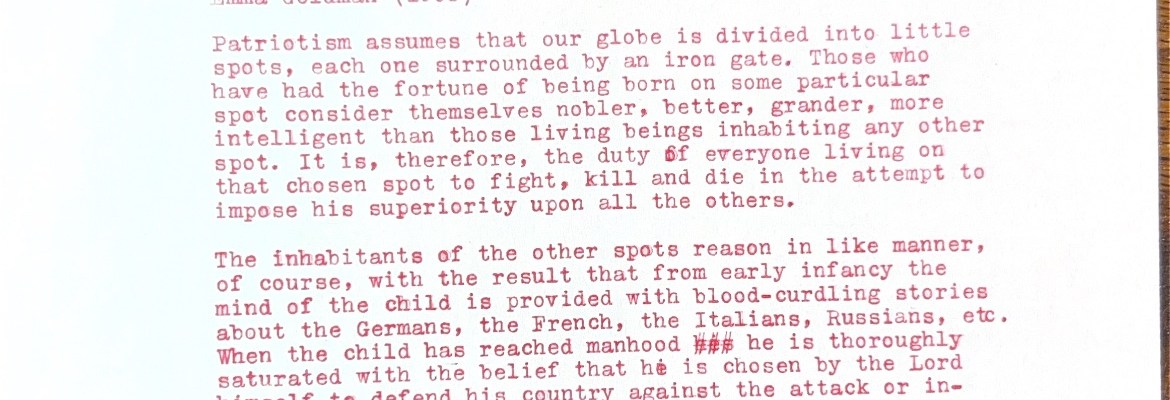

Emma Goldman’s 1908 speech “What Is Patriotism?” is a scathing critique of American nationalism as an instrument of power, not collective well being. Goldman’s rhetorical strategy is prevalent in the metaphor of the world as “spots” and “iron gates.” These images buttress her argument that national borders are artificial constructs imposed through violence and maintained for the ruling class.
The phrase “spots on the globe” is the image of a world fractured by arbitrary borders, that Goldman argues do not arise naturally, but result from conquest, colonization and political maneuvering. Instead of symbols of progress, these borders are blemishes, evidence of the human impulse to divide and be antagonistic. Goldman’s analysis puts the map not as a neutral tool, but as a record of historical violence and exclusion.
The “iron gates” intensifies this critique, grounding the abstraction of borders in the material reality of enforcement. Borders are not just lines on a map, they are physical barriers, armed guards and surveillance. The state is the coercive power that sustains borders through exclusion and the threat of force. Goldman argues that patriotism is not a universal ideal, but the systematic exclusion of the poor and vulnerable while allowing the movement of capital and power. This is anticipating later analysis of global inequality where borders are the mechanism to regulate labor and maintain economic hierarchies.
Goldman’s argument also exposes the internal contradictions of nationalist ideology. If patriotism were virtuous it would unite not divide. The presence of “iron gates” shows that nationalism is not an ethical ideal, but rather a means of pitting working people in different countries against each other. Those in power profit from this conflict. The metaphor extends to the psychological effects of nationalism that create mental “gates” and suspicion of the “other.”
The relevance of Goldman’s critique is evident in the current debates on immigration, border security and refugees. Modern policies have amplified the dynamics described: borders are more militarized and patriotic. This rhetoric obscures the reality of economic exploitation and social exclusion. The “spots on the globe” have become more entrenched, reinforced by advanced technology of surveillance and exclusion. In the end Goldman’s vision is to dismantle these artificial barriers. She asks us to imagine forms of solidarity and freedom beyond the nation-state. By not being patriotic she is advocating for an ethic of universal liberty and mutual aid. The “iron gates” metaphor stays with as a powerful reminder that borders are not natural facts, but contingent structures — made and maintained by human beings and thus subject to change.

 Albertson Writes